
Peritoneal Dialysis Outcomes and Practice Patterns Study (PDOPPS)
Advancing peritoneal dialysis care through global prospective evidence.
Advancing peritoneal dialysis care through global prospective evidence.
About PDOPPS
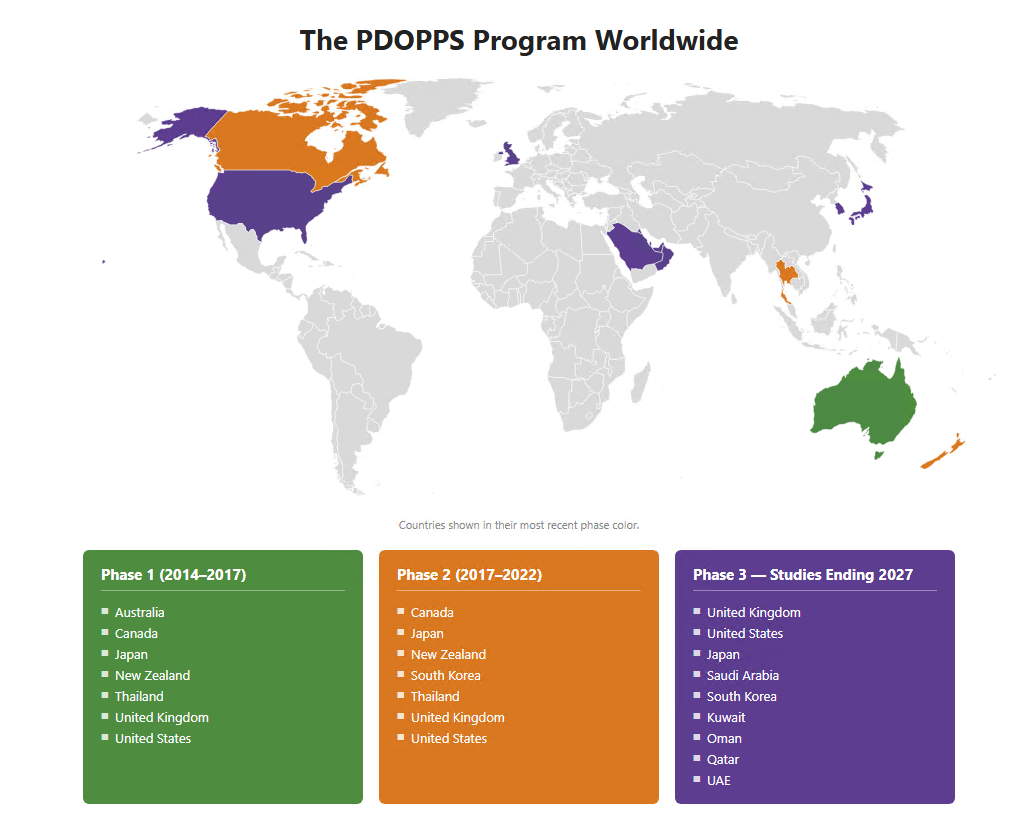
PDOPPS is the leading international prospective research initiative dedicated to understanding and improving care for patients receiving peritoneal dialysis (PD).Launched as an expansion of the DOPPS mission, PDOPPS is designed to identify best practices, extend technique survival, and improve quality of life for PD patients worldwide. The study operates in close partnership with the International Society for Peritoneal Dialysis (ISPD), reflecting the global PD community’s commitment to evidence-based care.
PDOPPS uses a hybrid data model combining prospective data collection — including patient enrollment, questionnaires, patient reported outcomes (PROs), and clinical follow-up at participating sites — with electronic health record (EHR) data extracts, enabling both rich patient-level detail and efficient, scalable data capture.
As the imperative grows to increase use of home-based dialysis modalities, PDOPPS is uniquely positioned to provide the evidence base for PD optimization globally.
PDOPPS is actively enrolling. Learn how your center can participate.
| PDOPPS at a glance |
| Resources |
| Get Involved |
Featured Research Impact
International Peritonitis Rates and Modifiable Risk Factors
PDOPPS provided the first large-scale, standardized international comparison of PD-related peritonitis rates, revealing important between-country variation. The study identified modifiable facility practices associated with lower infection risk, including higher use of automated PD, antibiotic prophylaxis before catheter insertion, and longer PD training duration. These findings have directly informed ISPD guideline discussions around acceptable peritonitis thresholds.
Quality of Life, Disease Burden, and Employment
A landmark PDOPPS publication, recognized in AJKD’s top-cited collection, compared quality of life and employment across PD and hemodialysis patients in six countries. PD patients reported a substantially lower burden of kidney disease than HD patients, while mental well-being and depression levels were similar across modalities. Functional status emerged as one of the strongest predictors of all patient-reported outcomes — underscoring the importance of routine functional assessment in dialysis care.
Pruritus in Peritoneal Dialysis
PDOPPS demonstrated that 43% of PD patients across seven countries experience moderate-to-extreme pruritus — a condition previously studied mainly in hemodialysis. Pruritus was independently associated with higher risk of death or transfer to HD, underscoring a major unmet symptom management need in the PD population.
International PD Prescription Variation
PDOPPS revealed substantial international differences in PD modality use (CAPD vs. APD), prescribed dialysis volumes, and use of icodextrin, with U.S. patients notably underutilizing icodextrin relative to other countries. These findings provide actionable benchmarks for optimizing PD prescriptions worldwide.
Thank you to our sponsors

formerly Baxter
 |
 |
|---|