
Share
Arbor Capabilities for AI-Assisted Technical Assistance
As public health programs scale, technical assistance must become faster, more consistent, and more data-informed—without sacrificing quality, trust, or human judgment. Arbor Research brings a practical model for AI-assisted TA that combines public health expertise, secure technology operations, and continuous quality improvement.
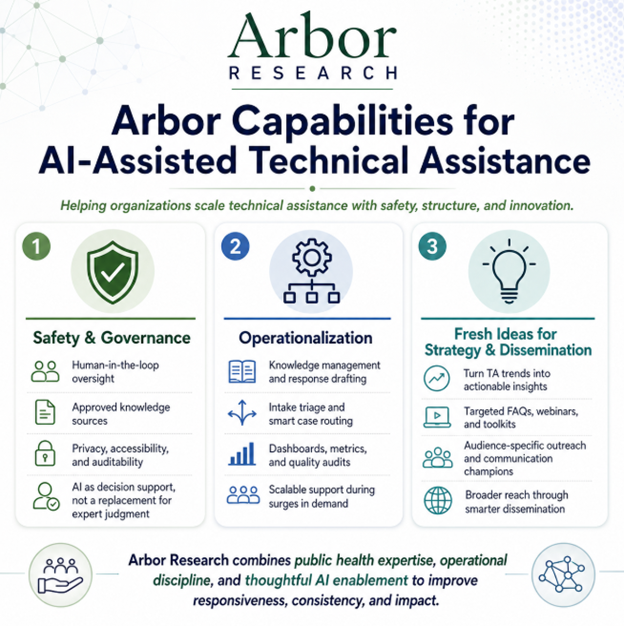
1) Safety and Governance
AI-assisted TA must be governed before it is deployed. Arbor emphasizes human-in-the-loop review, approved knowledge sources, role-based access, auditability, privacy protection, accessibility, and alignment with federal information security, data governance, and AI policy expectations. Our approach treats AI as a controlled decision-support and knowledge-management capability—not as a substitute for official policy interpretation, program eligibility decisions, or subject matter expert judgment.
2) Operationalization
AI only creates value when embedded into real workflows. Arbor can operationalize AI-assisted TA through structured knowledge bases, intake triage, response drafting, case routing, quality audits, Salesforce-enabled dashboards, performance metrics, and feedback loops. This supports faster response times, more consistent answers, better identification of recurring questions, and more scalable support during surges in demand.
3) Fresh Strategy and Dissemination Ideas
AI-assisted TA should also help programs learn from the questions they receive. Arbor can use TA trends, platform analytics, user feedback, and content gaps to inform targeted outreach, FAQs, short-form explainers, webinars, newsletters, stakeholder toolkits, and partner “communication champion” strategies. The result is not just better helpdesk performance—it is a smarter dissemination engine that turns individual TA requests into systemwide learning and broader program impact.
For mission-driven programs like the National Diabetes Prevention Program Customer Service Center, the opportunity is clear: use AI carefully, govern it rigorously, and apply it where it can improve responsiveness, consistency, reach, and continuous improvement.
Registries & Analytics Ask your data a question. Get an answer. We link the clinical health and quality registries we steward to dynamic, interactive dashboards, built with AI assistance from the start. The newest piece is a layer that lets people interrogate the data directly, in plain language, instead of waiting in an analyst queue.